
Retirement Gal

All Things for a Secure Retirement

  • Home
  • About
    • Terms of Use
  • Contact

The Path to $1 million

  • Retirement
Share:
fb-share-icon
Tweet

Only about 1% of the 30 million or so people who contribute to their Fidelity retirement accounts have managed to save at least $1 million. The average 401(k) balance hovers around the $100,000 mark.

So it must be near impossible for regular folks to reach seven-figures heading into those golden years, right? However, the numbers suggest otherwise.

In a post resurfaced on the” “Wealth of Common Sense” on Thursday, Ben Carlson of Ritholtz Wealth Management shows what it takes to hit $1 million by 65 years old. The key, as you probably already know, is getting started young and, ideally, putting away the full $19,000 allowed in 401(k) contributions.

The problem, of course, is that so few investors actually save that much. Vanguard research shows that just 4% of those earning $50,000 and only 11% of participants earning between $50,000 and $100,000 max out contributions. The number rises to 32% for those making more than six figures.

For those who hit their maximum allottable savings, the path doesn’t look all that daunting, as you can see by this chart, which uses the 2018 max of $18,500:
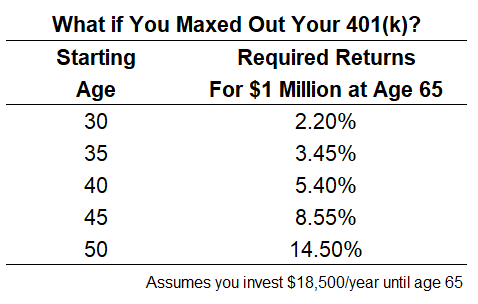
In other words, if you start investing at an earlier age, around 30, the market needs to return on average only a not too unreasonable 2.2% to hit 401(k) millionaire-dom, compared against the roughly 9% average return an investor would need to generate starting at, say, 45. The takeaway – wait to start saving until you’re in your late-40s or 50s and it is much harder to get to seven figures.

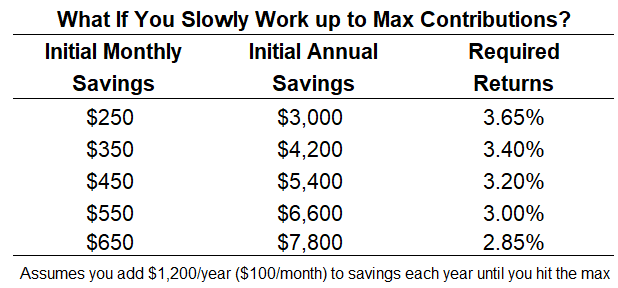
In reality, most people would be more comfortable steadily increasing their contributions rather than maxing out from the beginning. In that case, Carlson offered up this path for 30-year-olds aiming to reach $1 million by 65.
“Everything looks easier on paper than in real life, especially when money’s involved,” he said. “It would be irrational of me to suggest ‘everyone’ should be able to be a 401(k) millionaire because getting your finances in order is no easy task.”

Source

401(k) Retirement Plan Contributions Retirement Savings
April 30, 2019 Melanie

Post navigation

How Do You Define Retirement? → ← Land of Enchantment

Connect with Us

RSS
Facebook
Facebook
fb-share-icon
Twitter
Visit Us
Follow Me
Tweet
LinkedIn
Share
YouTube
Follow by Email
Financial Perspectives

More from Us

As part of Financial Perspectives, we share our unique view through these other affiliated blogs:
Financial Perspectives
Investment Edge
Retirement Corner
The Sharp Chartist

Recent Posts

Expect the Unexpected

Expect the Unexpected

Share:

More Info
10 Ways Retirement Has Changed Over the Last Decade

10 Ways Retirement Has Changed Over the Last Decade

Share:

More Info
It’s RMD Season!

It’s RMD Season!

Share:

More Info
2020 Adjustments for Taxes and Contributions

2020 Adjustments for Taxes and Contributions

Share:

More Info
Social Security 2020

Social Security 2020

Share:

More Info
How Life Expectancy Impacts your Retirement Plan

How Life Expectancy Impacts your Retirement Plan

Share:

More Info
Like Squeezing Blood Out of a Turnip

Like Squeezing Blood Out of a Turnip

Share:

More Info
Breaking Bad Habits

Breaking Bad Habits

Share:

More Info
Break Out Those “Childproof” Locks

Break Out Those “Childproof” Locks

Share:

More Info
Real (Purchasing) Power

Real (Purchasing) Power

Share:

More Info

Disclaimer

The information provided on the Blog is provided for informational purposes only and should not be used as a substitute for personalized professional financial advice. Participation in any way with the Blog does not constitute an investment advisory, financial or retirement planning engagement. You should consult with your investment adviser or another financial professional before making any investment decisions. While all information on the Blog is gathered from sources that we deem to be reliable, we cannot guarantee the completeness and/or accuracy of such information. From time to time general investment guidance may be given in the Blog in response to questions asked by readers of the Blog. There is no guarantee as to the risk, returns, and performance of any investments referenced herein.

Copyright Retirement Gal and Financial Perspectives | Terms of Use